

Innovative Uses of Stainless Steel in Modern Industries
Key Takeaways
- Stainless steel’s adaptability and durability enable it to thrive across sectors such as aerospace, medicine, and energy.
- Technological advances such as 3D printing and AI-based production refine the precision and scope of stainless steel applications.
- Its recyclability and robust lifecycle promote sustainability and efficiency across numerous industries.
Stainless steel continues to shape the future of industrial sectors with its unmatched blend of strength, longevity, and aesthetic appeal. In recent years, forward-thinking businesses have harnessed the potential of stainless steel for new applications, driven by digital transformation and breakthroughs in material science. If you are searching for a reliable supplier, a stainless steel distributor Houston, TX can provide the expertise and product range needed to meet contemporary industry demands.
From aerospace to renewable energy, stainless steel is now celebrated not only for its traditional roles but also for its integration into modern industries’ innovative processes. Advanced manufacturing techniques and smart infrastructure are just a few areas where stainless steel’s unique properties have proven invaluable, solidifying its reputation as a vital material for the 21st century and beyond.
Advancements in Manufacturing Techniques
The trajectory of stainless steel manufacturing has evolved substantially, driven by cutting-edge technologies that enhance productivity and quality across sectors. Laser cutting, for example, enables fabricators to produce intricate shapes and custom components with remarkable accuracy and minimal waste. Adoption of 3D printing, or additive manufacturing, enables the production of prototypes and parts that were previously impossible or too costly to produce using conventional methods.
Industries such as aerospace and automotive benefit significantly from these advances. Components are now lighter yet stronger, resulting in improved fuel efficiency and performance. AI-driven automation and robotics further optimize these manufacturing processes, reducing production time and costs.
Applications in Renewable Energy
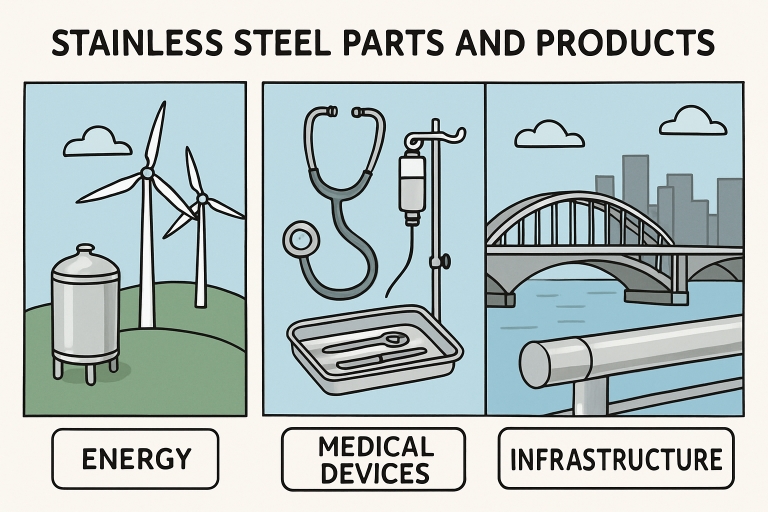
Renewable energy is a rapidly expanding field where the advantages of stainless steel are highly prized. Its robust nature and excellent corrosion resistance make stainless steel the foundation for durable wind turbine parts and mounts and frames for solar panels. Especially in the challenging environments of offshore wind farms, stainless steel ensures that these massive investments operate efficiently with minimal maintenance. The material’s reliability reduces downtime and costs, extending the operational lifespan of vital energy infrastructure.
Role in Healthcare and Medical Devices
Stainless steel plays a key role in healthcare, used for surgical instruments, implants, and medical equipment due to its biocompatibility and its ability to be sterilized. Innovations in alloy composition and processing have improved safety and durability. Recent advances focus on new alloys and coatings to enhance performance. As surgical techniques evolve and demand rises, hospitals and manufacturers favor stainless steel for its reliability and affordability.
Integration in Smart Infrastructure
Modern smart infrastructure relies on durability, resilience, and the integration of digital technologies. Stainless steel meets these demands by serving as a reliable building material for bridges, tunnels, high-rise buildings, and other critical projects. Increasingly, stainless steel structures are being paired with embedded sensors that continuously monitor conditions such as stress, temperature, and corrosion. This real-time monitoring enables proactive maintenance, enhances disaster resilience, and reduces long-term repair costs.
The integration of data from these sensors enhances urban safety and performance metrics, allowing city planners and engineers to make informed decisions about building upgrades and maintenance schedules. Cities around the world are using smart infrastructure solutions to build a more sustainable and responsive future.
Enhancing Sustainability Through Recycling
Stainless steel’s notable feature is its recyclability; unlike other materials that degrade after recycling, it maintains its properties indefinitely. This reduces reliance on raw materials, energy use, and greenhouse gases. Industries focused on the circular economy see stainless steel as vital for sustainability, waste reduction, and resource efficiency, helping them meet environmental and economic goals.
Future Prospects and Innovations
Research and development are unlocking greater benefits for stainless steel, with innovations like hydrogen-based production reducing the carbon footprint of traditional smelting. Ongoing exploration of new alloys, surface treatments, and manufacturing systems will expand its capabilities. Sustainable development and technological progress reinforce stainless steel as a future-proof choice for industry. Its performance, recyclability, and adaptability ensure a pivotal role in shaping industries. As industry needs evolve, continuous innovation and responsible practices will keep stainless steel vital for future technology and infrastructure.
Conclusion
In conclusion, stainless steel continues to demonstrate its versatility, durability, and sustainability across a wide range of industries. From precision manufacturing and aerospace to renewable energy, healthcare, and smart infrastructure, advancements in processing, automation, and alloy development have expanded its applications and performance. Its recyclability and potential for low-carbon production further strengthen its role in sustainable development. Looking ahead, ongoing innovations in materials, manufacturing techniques, and smart integration ensure that stainless steel will remain a cornerstone of modern industry, supporting efficient, resilient, and environmentally responsible solutions for the challenges of tomorrow.