
Chess Sets Through the Ages: A Look at History and Design
Key Takeaways
- Chess sets have evolved from abstract Islamic designs to intricate medieval pieces and modern minimalist styles.
- Notable historical sets include the Charlemagne chessmen, Lewis chessmen, and the Bauhaus chess set by Josef Hartwig.
- Designs often reflect cultural influences and artistic trends of their time.
Introduction
Chess is a timeless game that transcends borders and boasts a rich, fascinating history. The evolving artistry of chess pieces reflects not only advancements in craftsmanship but also the cultural and religious values of societies throughout the centuries. For collectors and enthusiasts, figural chess sets capture the diversity and beauty of this historic journey, each one serving as a miniature work of art reflective of its time and place.
The array of chess set designs—from early abstract shapes to highly detailed and themed creations—offers a glimpse into the game’s lasting allure and its intersection with global artistic trends. Whether displayed for their decorative charm or used for spirited matches, chess sets tell a compelling story of how innovation and tradition shape even the most minor details of our enduring games.
Early Islamic Designs
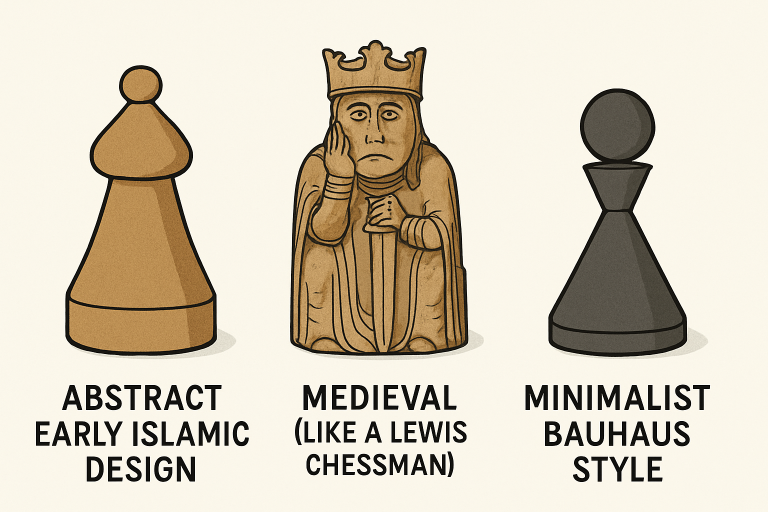
Chess arrived in the Islamic world around the 7th century. Religious beliefs that forbade the depiction of living beings led artisans to design pieces with abstract forms, eschewing faces and figurative imagery. Kings and queens appeared as embellished thrones, bishops as stylized elephants’ tusks, and knights as abstracted horse heads. The result was a set of pieces where symbolism, not realism, dictated form—sometimes so utilitarian that only experienced hands could tell the difference during play.
Symbolism and Functionality
This abstract approach did more than adhere to religious doctrine; it fostered an environment where the very movement of each piece could be expressed through shape. These early chess sets prioritized function and meaning, influencing later artistic developments in both Eastern and Western chess traditions. For a broader understanding of how religious beliefs continue to influence artistic design, see The Metropolitan Museum of Art’s overview of Islamic art.
The Charlemagne Chessmen
The famed Charlemagne chessmen, dating back to the 11th century, mark a pivotal moment in European chess history. Crafted from ivory and widely attributed, though incorrectly, to Emperor Charlemagne himself, they likely originated in Salerno, Italy. These pieces show a shift from the heavily abstract to the more representational, with subtle human and animal features sculpted into their forms.
While their connection to Charlemagne is rooted in legend, the craftsmanship reveals the artistic inclinations of the High Middle Ages. With robed figures, regal animals, and ornate thrones, the set straddles the line between functional game pieces and elaborate figurative sculptures, a harbinger of later European design innovation.
The Lewis Chessmen
Discoveries can change our understanding of history, and few finds are more illustrative than the Lewis chessmen. Unearthed in 1831 on the Isle of Lewis in Scotland, this 12th-century set astonished historians and collectors with its emotive, detailed walrus ivory carvings. Kings sit solemnly, queens rest pensive heads on hands, and knights astride horses evoke the martial valor of medieval Norse society.
Medieval Masterpieces
The Lewis chessmen are a rare window into the cultural and social realities of their creators. Their expressive faces and individualized attire capture the mystique and pageantry of medieval life, making them invaluable to both art history and the evolution of chess. For more about the cultural significance of the Lewis chessmen, visit the British Museum’s collection.
The Selenus Chess Set
The Selenus chess set emerged onto the European scene in the 17th century, particularly gaining popularity in Germany and Northern Europe. Named for Gustavus Selenus—the pen name of Duke Augustus the Younger of Brunswick-Lüneburg—these sets are marked by their tiered, lathe-turned bases and finely detailed crowns. Kings and queens are depicted as fountains, while bishops and pawns are rendered as lavishly designed flowers, evoking formal garden motifs.
These sets were as much ornamental displays as they were functional playthings, reflecting the Baroque appetite for extravagance and symmetry. The Selenus sets connect chess to broader themes of nature, courtly life, and social hierarchy, demonstrating how design adapts to mirror societal ideals.
Bauhaus Influence: Josef Hartwig’s Design
By the 1920s, chess set design had begun to embrace the ethos of the modern age. The Bauhaus movement, renowned for marrying function with form, found a champion in Josef Hartwig. His 1923 chess set eschewed figurative representation entirely. Instead, each piece was a minimalist geometric shape, physically embodying its allowed moves: cubes for rooks, cubes and cylinders for bishops, L-shaped knights, and so forth.
Hartwig’s design made the game accessible and intelligible at a glance. It aligned with the emerging principle that beauty in objects stems from utility and clarity, rather than elaborate ornamentation. To explore how Bauhaus principles shaped modern design, read this Architectural Digest feature.
Modern Variations and Cultural Influences
The diversity of chess set design has only increased in recent decades, as artists and cultures reinterpret classical themes. Today’s chess sets range from thematic Hollywood and pop culture editions to strikingly abstract and regional versions, such as those featured in the World Chess Hall of Fame’s “Chess Variants: Transforming Tradition” exhibition. This display features sets from Asia, such as Shogi and Janggi, alongside intricate artistic collaborations from around the world.
Contemporary designers continue to push the boundaries of what constitutes a chess set, using novel materials and technology while paying homage to the legacy of past masters. Whether for play or display, these sets underscore the game’s role as a living canvas for cultural innovation and expression.
Conclusion
The journey of chess set design is a story of cultural transformation and artistic ingenuity. From the non-figurative shapes of early Islam to medieval masterpieces like the Lewis chessmen and avant-garde Bauhaus experiments, every set reveals new facets of human creativity and tradition. As the global love affair with chess endures, so too does the vibrant evolution of its sets—inviting us to play not just with pieces, but with history itself.